- Overview
- PRODUCTS
- Cleaning & Disinfection
- Sterilisation & Monitoring-All
- Steam Sterilisation Monitoring
- VH202 Sterilisation Monitoring
- EO Sterilisation Monitoring
- View All Products
- Knowledge Centre
- Cleaning & Disinfection
- Sterilisation & Monitoring
- Biological Indicator Technology
- FAQs
- View All Best Practices
- RESOURCE
- Support

-
Steam sterilisation is a method of sterilisation in which moist heat in the form of saturated steam under pressure is used for sterilising surgical instruments. Moist heat helps destroy microorganisms, this is achieved through irreversible coagulation and denaturation of enzymes and structural proteins. It is the most widely used method of sterilisation and valued for being non-toxic and inexpensive. Steam sterilisation exposes each item to direct steam contact at the required temperature and pressure for a specified time. The ideal steam for sterilisation is dry saturated steam and entrained water (dryness fraction ≥97%) as per CDC guidelines.


-
Load Monitoring for Steam Sterilisation
Load monitoring is the process by which a load is monitored and released based on the final negative result of a Biological Indicator (BI) in a Process Challenge Device (PCD). According to ANSI/AAMI ST79, a BI should be used weekly, preferably daily, in each steam steriliser and in every load that contains an implant. Only a BI can detect the actual killing of microbial monitoring non-implant loads. As a best practice and to provide optimal patient safety, 3M recommends that every sterilisation load be monitored with an appropriate biological indicator.
Load Monitoring Featured product
-
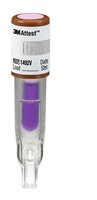
3M™ Attest™ Super Rapid Readout Biological Indicator
With 3M™ Attest™ Super Rapid Readout Biological Indicators you can get biological indicator results for pre-vacuum steam sterilisation cycles in just 24 minutes (about the time it takes to cool a load). For faster sterility assurance and peace of mind in record time, rely on the 3M™ Attest™ Super Rapid Readout Biological Indicator System.

-
3M™ Attest™ Super Rapid Readout Biological Indicator Systems are not only built for speed, they help maintain accuracy standards that are critical to the process of sterilisation. You may have heard that all Super Rapid Biological Indicators are the same. Perform the same. Read the same. Give the same assurance. It is important to understand the differences that can impact the outcome of your quality assurance system and potentially compromise patient safety. When selecting a Super Rapid Biological Indicator, make sure that you review the features of the system, and that its implementation is easy and seamless for your team.
14 ways the 3M™ Attest™ Super Rapid Readout Biological Indicator System is in a class of its own

-
Pack Monitoring for Steam Sterilisation
Pack monitoring products verify whether sterilant has penetrated to the area where the Chemical Indicator (CI) was placed within the pack. These Type 4, Type 5, or Type 6 chemical indicators (as defined by ISO 11140-1:2014) are designed to react to two or more of the critical variables required for sterilisation to occur—for steam sterilisation, the critical variables are time, temperature, and the presence of steam.
Only Type 5 Integrating Indicators measure all three critical variables and correlate with a biological indicator at three time/temperature relationships under ideal steam sterilisation conditions. It is a best practice to use a Type 4, Type 5, or Type 6 Pack Monitoring Chemical Indicator inside every pack.
Pack Monitoring Featured product
-
3M™ Comply™ SteriGage™ Chemical Integrators
Simple to use and easy to interpret, 3M™ Comply™ SteriGage™ Steam Chemical Integrators feature a “moving front” style readout for straightforward “Accept” or “Reject” results. This Type 5 Integrating indicator correlates to the performance of a biological indicator at three time/temperature relationships under ideal steam sterilisation conditions.
-
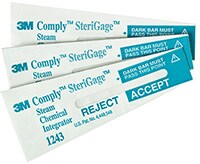
3M™ 1243 Comply Steam Chemical Integrator
-
Placement of Chemical Indicators
An internal chemical indicator such as the 3M™ Comply™ SteriGage™ Chemical Integrator should be placed inside each package in the area, or areas, that are most difficult for sterilant to penetrate. Always read and understand manufacturers’ instructions for use (for the chemical indicator, device, and/or container).
Refer to this chemical indicator placement poster for recommendations (PDF, 1,203.6 KB)
How to read your steam Comply™ Sterigage™ Steam Chemical Integrator Results

-
Equipment Monitoring for Steam sterilisation
Equipment monitoring reveals whether or not your steriliser is doing its job properly. For monitoring vacuum-assisted steam sterilisers, begin each day with a 3M™ Comply™ Bowie-Dick Plus Test Pack. The test is designed to detect air leaks, inadequate air removal, inadequate steam penetration, and the presence of non-condensable gases — any of which can compromise sterility.
Equipment Monitoring Featured products
-
3M™ Comply™ Bowie-Dick Plus Test Pack 00135LF
Designed for dynamic-air-removal sterilisers, the Comply Bowie-Dick test pack is used to measure the efficacy of the vacuum system in removing air from the steriliser chamber and detect leaks in the system.
Features include:
- An indicator pattern that is easy to read and interpret
- Lead-free ink to eliminate hazardous waste issues
- An early warning test sheet that can provide advance notice of steriliser problems, so the steriliser can be repaired before it must be taken out of use.
-
Interpreting Results - Know How to Read the Results of your 3M™ Comply™ Bowie-Dick Plus Test Pack
The 3M™ Comply™ Bowie-Dick Plus Test Pack is designed to evaluate the effectiveness of the air removal system in pre-vacuum steam sterilisers and to detect residual air in the chamber. A uniform color change to dark brown/black is a PASS. A non-uniform color change showing a lighter-coloured area in the center of the test sheet is a FAIL, indicating residual air in the steriliser chamber. We’ve created a chart to help with interpretation of the test results.

-
Exposure Monitoring for Steam sterilisation
Know at a glance whether packs have been exposed to the sterilisation process with our easy-to-read exposure monitoring products. Our exposure monitoring indicator tapes and labels provide clear evidence that packs have been processed. These process indicators undergo a colour change when exposed to sterilant.
For best results, always place a Type 1 Process Indicator on the outside of every pack, wrapped tray, container, or peel pouch, unless the internal chemical indicator is readily visible.
Exposure Monitoring Featured products
-
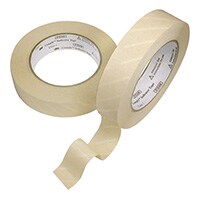
Interpretation Guides for Steam Indicator Tape
3M™ Comply™ Indicator Tapes 1322 and 1355 are exposure monitors that not only seal packs securely, but also provide at-a-glance visual assurance that the package has been exposed to the steam sterilisation process. They are Type 1 Process Indicators (as defined by ISO 11140-1:2014) and their purpose is to differentiate between exposed and unexposed packs.
Your Guide to Interpreting Comply Indicator Tape 1322 Results
